Start with a problem rather than a definition, because the structure falls out of the problem almost by itself.
You have two copies of a dataset — a database replica, a backup, a mirror of an artifact store. Call it two terabytes. They’re supposed to be identical. You’d like to know whether they are, and if not, which part differs. The link between them is not fast, and reading two terabytes on each side to compare is both slow and expensive.
Work through the obvious approaches and the answer builds itself.
Send everything and compare. Correct, and it costs two terabytes of transfer. That’s the thing we’re trying to avoid.
Hash the whole dataset on each side and compare one hash. Now you transfer 32 bytes. Beautiful — and nearly useless, because when the hashes differ you’ve learned only that something is wrong, with no idea what. You’re back to transferring everything.
Hash each block separately. Split into 4 KB blocks and hash each. Now you can find exactly which blocks differ. But two terabytes at 4 KB is about 500 million blocks, and 500 million hashes at 32 bytes each is 16 GB of hashes. Better than two terabytes. Still terrible.
The problem with the last approach is that it’s flat. You either compare one hash (too coarse) or all of them (too many). What you want is to start coarse and get finer only where it matters.
So: hash the blocks. Then hash pairs of those hashes. Then pairs of those. Keep going until you’re left with one.
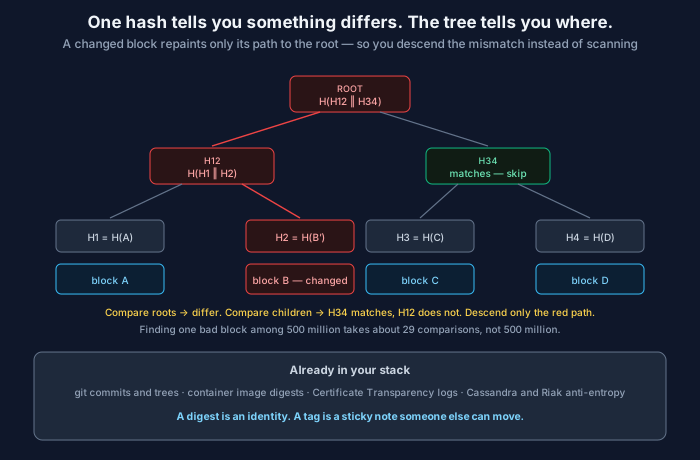
That’s the whole construction. The leaves are hashes of data blocks, each internal node is the hash of its children concatenated, and the single value at the top — the root hash — summarises everything beneath it.
Why it works
Compare roots first. One value, 32 bytes.
If they match, you’re done. The datasets are identical, and you proved it by transferring 32 bytes.
If they differ, ask for the root’s two children. One subtree will match and one won’t — the mismatch tells you which half contains the difference. Descend into that half. Ask for its two children. Repeat.
Each step halves the search space, so you reach the differing block in about log₂(n) steps. For 500 million blocks that’s roughly 29 round trips, each one exchanging a handful of hashes. You’ve located a single corrupt 4 KB block in a two-terabyte dataset having transferred a few kilobytes.
And if several blocks differ, you follow every branch that mismatches, so the cost scales with the number of differences rather than the size of the data. That’s the property that makes this useful in practice: reconciliation costs what the drift costs, not what the dataset costs.
A tampered block changes its leaf hash, which changes its parent, which changes every ancestor up to the root. You cannot alter data anywhere in the tree without changing the root — not without finding a hash collision, which for SHA-256 is not a thing anyone is doing.
The second trick: proving membership
There’s a less obvious capability here, and it’s the one that powers the more interesting applications.
Suppose someone holds the root hash and nothing else, and you want to convince them that a specific block is part of the dataset. You don’t need to send the dataset. You send the block, plus the sibling hash at each level on the path from that block to the root.
They hash your block, combine it with the first sibling, hash that, combine with the next sibling, and so on. If they arrive at the root hash they already trust, the block is genuinely part of the dataset. If not, it isn’t.
That’s a Merkle proof, and its size is the depth of the tree. One million items gives you a proof of about twenty hashes — call it 640 bytes — to prove membership in a set you never transmitted.
The asymmetry is the point. Verifying costs almost nothing and requires almost no storage. That’s what lets a lightweight client check a claim made by a server it doesn’t trust.
Where it already is in your stack
Once the shape is familiar you start seeing it, and most of these you use daily.
Git. A commit hash isn’t an identifier assigned to a commit; it’s the hash of the commit’s content, which includes the tree hash, which includes the hashes of every subtree and blob. The whole repository is a Merkle DAG. This is why git fetch can work out what you’re missing by exchanging a few hashes, and why changing any historical commit changes every hash after it — rewriting history is loud by construction.
Container images. An image digest — sha256:a3f1... — is the hash of the manifest, which lists the digests of each layer. Pull by digest and you get exactly those bytes or an error.
This is worth dwelling on, because it’s the one with security consequences people miss. A tag is a mutable pointer. A digest is an identity. myapp:v2.1.0 can be repointed to different content tomorrow and your pull will succeed with no warning. myapp@sha256:a3f1... cannot. If your deployment pins tags, you do not have reproducible builds and you have a supply-chain surface — the attacker doesn’t need to compromise your registry’s storage, just the mutable pointer. This is the same class of problem as agent skills installed from the internet: the name you asked for and the bytes you got are only connected by someone’s promise.
Certificate Transparency. Every publicly trusted TLS certificate is logged in an append-only Merkle tree. A CA that issues a certificate for your domain without telling you still has to log it, and you can monitor the log. Two proof types do the work: an inclusion proof shows a certificate is in the log, and a consistency proof shows the log’s new root is an extension of the old one rather than a rewrite. That second one is what makes “append-only” verifiable rather than merely claimed. The same structure now underpins the transparency logs appearing in software supply-chain tooling.
Anti-entropy in distributed databases. Dynamo-style systems — Cassandra, Riak — compare Merkle trees between replicas to find divergent key ranges without streaming everything. The original use case, exactly as derived above.
Blockchains, where each block’s header carries the Merkle root of its transactions, so a light client can verify a transaction was included without storing the chain. It’s a real use, though it’s unfortunate that it’s the one that made the structure famous, because it’s far from the most common.
The details that matter in practice
Three implementation notes, because the simple version has sharp edges.
Second-preimage resistance needs domain separation. A naive tree where leaves and internal nodes are hashed the same way lets an attacker reinterpret internal nodes as leaves and produce a different dataset with the same root. The fix is cheap: prefix leaves with one byte and internal nodes with another before hashing. Certificate Transparency does exactly this. If you build your own tree, do it — and if you’re using a library, check that it does.
Odd numbers of nodes need a rule, and the rule is load-bearing. Bitcoin duplicates the last hash when a level has an odd count, which introduced a real vulnerability because two different transaction lists could produce the same root. Promote the odd node unchanged instead. Whatever you choose, write it down, because two implementations that disagree about it will compute different roots for identical data and the mismatch will look like corruption.
Block size is a genuine trade-off. Smaller blocks locate differences more precisely and make the tree taller and the hashing more expensive. Larger blocks are cheaper and mean a one-byte change forces you to re-transfer the whole block. The right answer depends on whether your changes are clustered or scattered, which is an empirical question about your data, not a theoretical one.
The transferable idea
Strip away the tree and what’s left is: name things by what they are, not by where they are or what someone called them.
A content address can’t go stale, because any change produces a different address. Caching needs no invalidation logic — a cache keyed by content hash is correct forever, which is why build systems like Bazel and Nix are built on this and why their caches can be shared across machines without trusting them. Deduplication is automatic: identical content has one name. And integrity verification stops being a separate step, because checking that the hash of what you received matches the name you asked for is the verification.
The cost is that you lose human-readable names, which is why every real system keeps a mutable layer on top — tags pointing at digests, branches pointing at commits. That layer is a convenience, and the thing worth remembering is that it is also where the trust goes. The digest is the identity. The tag is just a sticky note someone can move.
Related: Your agent installs Markdown from the internet and runs it · TLS and Public-Key Cryptography, Explained Without the Math · Hash Tables: The Data Structure Behind Almost Everything
Comments