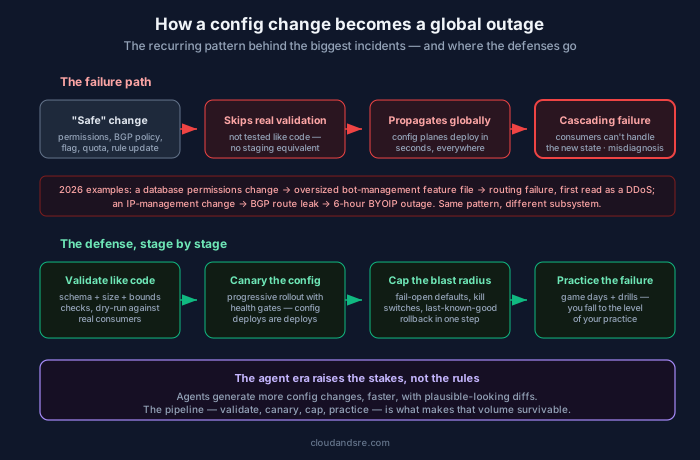
Every few months the industry gets another reminder, and 2026 has already delivered several. A database permissions change generated an oversized bot-management feature file; the routing software that consumed the file couldn’t handle it and failed — an event that looked so much like an attack that it was initially read as a DDoS. A few months later, an IP-management change leaked BGP routes and withdrew customer prefixes, taking a BYOIP service down for six hours.
Different subsystems, same shape. And the shape is not new: look across six years of major cloud incidents and configuration changes are the leading cause — BGP and routing policy, capacity adjustments, firewall rules, flag flips, generated config artifacts. Not exotic bugs. Not zero-days. Edits that someone, quite reasonably, believed were safe.
I keep returning to this topic because the industry keeps not fixing it, and because we’re now entering a period — agents authoring operational changes — where the cost of not fixing it compounds.
The asymmetry that causes everything
Code changes earn our respect. They get review, CI, staging, canaries, and a rollback story, because decades of pain taught us to treat them as dangerous.
Config changes get a fraction of that scrutiny — and a multiple of the blast radius. The asymmetry has two halves:
Validation is thinner. A schema check, maybe. What’s routinely missing is validation against the consumer of the config. The bot-management failure is the canonical case: the file was generated correctly by its producer’s logic — the change was to database permissions, which changed what a query returned, which changed the file’s size. Nothing in the pipeline asked “can every consumer of this artifact handle this output?” The answer was no, and the routing layer found out in production. Testing has historically focused on application correctness while infrastructure and config settings go effectively untested — and those are the errors that produce the large failures.
Propagation is faster. We built config planes to be fast on purpose — flags that flip globally in seconds, routing policy that converges in moments. Speed of propagation is speed of damage. A bad code deploy at 5% canary is an incident; a bad config at global propagation is a headline.
Add the third ingredient — cascading dependencies, the second most common cause of major outages — and you get the full pipeline: safe-looking change → thin validation → global propagation → consumers failing in ways that don’t obviously point back to the change. That last property is why misdiagnosis is part of the pattern; when the symptom is “everything is failing,” the config edit from twenty minutes ago is rarely the first suspect.
The defense, stage by stage
Nothing here is novel; that’s rather the point. It’s the discipline we already apply to code, applied to the change path that postmortem data says is more dangerous.
Validate like code. Schema, size, and bounds checks on every generated artifact — an explicit “this file should never exceed X entries” assertion would have converted a global outage into a failed pipeline run. Dry-run against real consumers: load the candidate config into the actual software that will consume it, in a sandbox, before it ships. If a permissions change can alter a query result that alters an artifact, the artifact’s tests — not the permission change’s reviewer — are your defense.
Canary the config. A config deploy is a deploy. Progressive rollout with health gates — one node, one region, then the world — with automatic halt on error-rate movement. This is uncomfortable precisely because config planes were built for speed, but you only need enough delay for your monitoring to vote. Seconds-to-minutes of staged propagation is usually plenty.
Cap the blast radius. Decide at design time what a consumer does with a malformed or oversized config: fail-open with last-known-good beats crash, nearly always. One-step rollback to a versioned previous config. Kill switches that are tested, not decorative — because an untested kill switch is a hypothesis, and production is a bad place for hypotheses.
Practice the failure. Both 2026 incidents were extended by diagnosis time, not just the trigger. You don’t rise to the level of your runbook; you fall to the level of your practice. Game-day the specific scenario: “a config change propagated globally and the symptom looks like an attack.” Teams that have rehearsed asking what changed recently, including config? find these in minutes; teams that haven’t, don’t. This is observability and incident-response fundamentals, pointed at the change path we keep exempting.
And administratively: count config changes against the same error budgets and change-management gates as code. An org that freezes deploys but not flag flips has frozen the safer path.
Now add agents
Here’s why this is urgent rather than merely evergreen: agents write config now. Remediation agents adjust quotas and flags, provisioning agents emit Terraform, copilots draft the permissions change and a human clicks approve. Volume goes up; each diff is syntactically clean and plausible; review attention per change goes down. Rubber-stamping is the failure mode — plausibility is exactly what LLMs optimize for, and plausible is not the same as safe in a system where a permissions edit can resize an artifact three systems downstream.
The rule that follows: no actor, human or agent, gets a config path around the pipeline. Agent-authored changes go through the same validation, the same canary, the same blast-radius caps — with a real identity attached so the audit trail says which agent, and under an autonomy budget that narrows when outcomes degrade. The optimistic read: agents are better than humans at tolerating slow, gated rollouts. They don’t get impatient and force-merge at 5 p.m. on a Friday. The pipeline is the safety mechanism; agents just remove the last excuse for not building it.
Honest caveats
Public postmortems are a biased sample — we learn the most from the companies most willing to publish, and Cloudflare’s transparency means their incidents are over-represented in everyone’s lessons file, including mine. Full config canarying is genuinely hard for some planes (BGP does not canary neatly), and last-known-good has its own failure modes when “last known good” is itself the problem. And there’s a cost argument I take seriously: staged config propagation gives up some of the speed the platform was built for. But the postmortem record has been saying the same thing for six years with remarkable consistency, and the volume of change is about to go up, not down. The teams that treat their config path as their most dangerous deploy pipeline — because it is — are the ones whose next surprise stays a failed pipeline run instead of a headline.
Sources: testRigor — Cloudflare outage lessons for SRE, IsDown — six years of cloud outage history, DevOps.com — lessons from the AWS and Cloudflare outages
Comments