The International Organization for Standardization came up with the Open Systems Interconnection (OSI) conceptual model which provides a standard for diverse computer systems to be able to communicate with each other using standard protocols. The OSI Model can be seen as a universal language for computer networking. It essentially splits the network communication system into seven stacked abstract layers. Each layer performs a specific function and employs a different protocol. A good understanding of the OSI layers makes it easy to troubleshoot complex network issues.
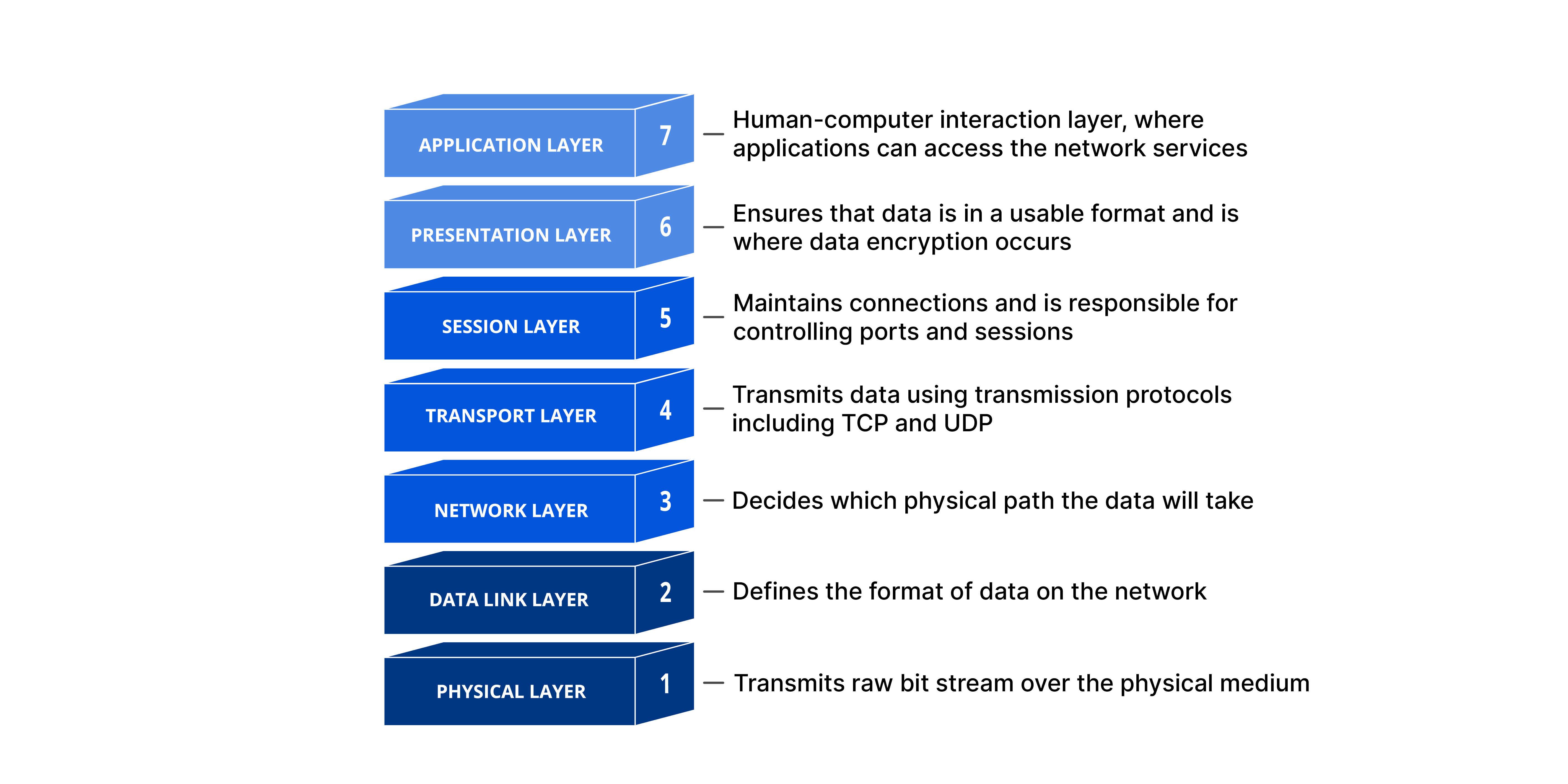 Image: Cloudflare
| Layer | Function |
|---|---|
| 7. Application Layer |
End User Layer — where human-computer interactions happen. The layer is responsible for protocols and data manipulation that software relies on to present meaningful data to the user (not the applications themselves). Protocols: HTTP, FTP, IRC, SSH, DNS, SMTP |
| 6. Presentation Layer |
Syntax layer — ensures data is in the right format. Handles encryption, translation, and compression of data received from Layer 7 before passing it to Layer 5. Protocols: SSL, SSH, IMAP, FTP, MPEG, JPEG |
| 5. Session Layer |
Responsible for opening and closing communication between two devices. Controls ports and synchronizes data transfer with checkpoints — e.g. if a large file transfer fails halfway, it can resume from the last checkpoint rather than restarting. Protocols: APIs, Sockets, WinSock |
| 4. Transport Layer |
Manages end-to-end connections. Breaks data from Layer 3 into Segments and reassembles them at the destination. Responsible for flow control and error control. Protocols: TCP, UDP |
| 3. Network Layer |
Controls the physical path data takes (routing). Connects two networks (not just devices) and splits segments into smaller units called Packets. Protocols: IP, ICMP, IPSec, IGMP |
| 2. Data Link Layer |
Facilitates data transfer between two devices on the same network. Breaks Packets into Frames and manages flow control and error control within a network. Operates at the MAC level. Technologies: Ethernet, PPP, Switch, Bridge |
| 1. Physical Layer |
The physical structure of the network — cables, switches, etc. Data is converted to bits/signals for transmission. Technologies: Coax, Fiber, Wireless, Hubs, Repeaters |
Comments