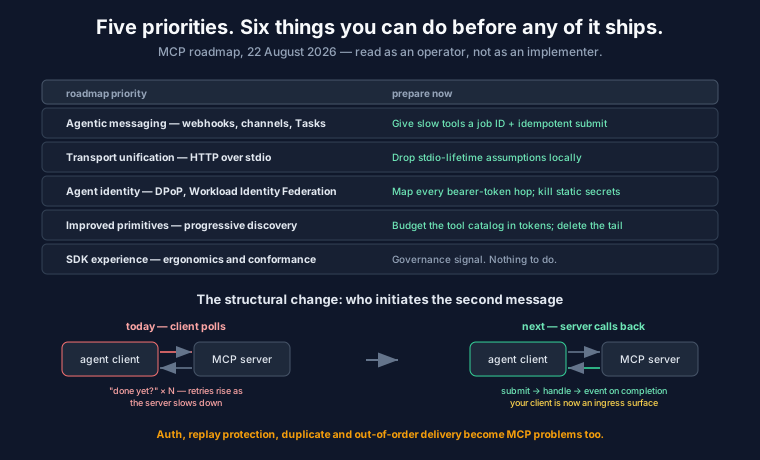
On 22 August 2026 the Model Context Protocol project published an updated roadmap covering the next specification release and beyond. It lists five priority areas.
Roadmaps are usually a low-information genre. This one is not, because three of the five items change how you operate MCP infrastructure rather than how you write against it — and because the last spec release, 2026-07-28, demonstrated that this project ships the things it says it will ship.
So here is the operator’s reading: what each priority is, what it actually changes, and what you can do about it before anything lands.
1. Agentic messaging: the polling loop is on the way out
The roadmap’s framing is blunt: “Modern agentic workloads no longer fit the standard request-and-response pattern.”
The commitments are server-initiated events — “webhooks and channels, so clients aren’t left polling for results” — and maturing the Tasks extension until it graduates into the specification proper.
Why this is the big one. Think about what your MCP servers actually wrap. In an SRE context it is things like: run a query across six months of logs. Trigger a deploy and report the outcome. Kick off a vulnerability scan. Reindex a corpus. None of those complete inside a request timeout, and today the honest answer is that the client polls.
Polling has a specific operational shape, and it is not a good one:
- Idle capacity burn. A held connection per in-flight tool call, multiplied by concurrent agent sessions.
- Retry storms under stress. When the server slows down, clients poll more, not less. That is the classic self-amplifying failure, and MCP servers are not exempt from it just because they are new.
- No clean expression of a job that outlives its client. If the agent session ends, who owns the running deploy? Today: nobody, or you built something bespoke.
- Timeouts as the only backpressure primitive. You cannot say “accepted, I will call you back,” so you say “still working” until someone gives up.
Server-initiated events fix the shape of this. A tool call becomes: accept, return a handle, deliver the result when it exists.
What to do now. Inventory your tool calls by duration. Any call whose p99 is over a few seconds is a candidate to become task-shaped, and the migration will be much easier if the underlying operation already has a job ID, a status you can query, and an idempotent submit. Most of them do not. That is work you can do this quarter that pays off no matter how the spec lands.
The second-order consequence is worth flagging: once servers call clients, your client is a server. That is an ingress surface, with authentication, replay protection, and delivery semantics to reason about. Every team that has run webhooks knows the failure modes — duplicate delivery, out-of-order delivery, the receiver that 500s and drops the only notification. Those become MCP problems too, and the people who will handle them well are the ones who already treat webhook receivers as production surfaces.
2. Transport unification: HTTP all the way down
The 2026-07-28 release made the protocol core stateless and made a remote MCP server look like any other HTTP workload. The roadmap extends that logic inward, to “local servers speaking Streamable HTTP over stdio,” with the rationale that “unifying on one transport lets us simplify MCP server and client development even further.”
This sounds like plumbing. It is plumbing. It is also the item with the highest ratio of operational benefit to conceptual difficulty, because today local and remote MCP servers are two different things to debug.
A local stdio server has no request IDs you can grep, no status codes, no standard way to attach a proxy, and no way to reuse the tracing you already run. A remote HTTP server has all of that. Collapsing the two means one mental model, one interception point, and one set of tooling.
What to do now. Stop writing local-only servers that assume stdio semantics — particularly anything that leans on process lifetime as a substitute for session state. The stateless discipline the last release imposed on remote servers is the discipline local servers are heading toward.
3. Agent identity: DPoP and Workload Identity Federation
The roadmap’s diagnosis of who is calling MCP servers now:
More and more of the callers are agents running as cloud workloads with their own identity, acting on behalf of a user who isn’t present.
That sentence contains the whole problem. Two commitments follow: finalize “Demonstrating Proof of Possession (DPoP) and driving its adoption,” and define “an opinionated path for agent identity and delegation through Workload Identity Federation.”
DPoP binds a token to a key the client holds, so intercepting the token is not enough to use it. This matters more for MCP than for a typical API because of how many hops a token takes: agent runtime, gateway, tool server, and often a downstream API behind that. Every hop is a log line, a memory dump, or a misconfigured trace exporter away from leaking a bearer credential that works for anyone who has it. DPoP makes the stolen copy worthless.
Workload Identity Federation is the answer to “what is this agent, and who says so.” It replaces the long-lived secret with platform attestation exchanged for a short-lived token — the same move that ended long-lived cloud keys in CI.
I have argued before that agents need identities, not API keys. The roadmap is the protocol layer catching up to that, and the word “opinionated” is doing real work: the value of a standard here is precisely that it forecloses the eleven bespoke delegation schemes that would otherwise exist.
What to do now. Find every place a bearer token crosses a process boundary in your agent stack and write it down. That list is your DPoP migration plan. Separately, if your agents authenticate to anything with a static secret in an env var, that is the Workload Identity Federation work, and it is worth doing on its own merits today.
4. Improved primitives: progressive discovery is a context-budget fix
Two items here. Better structure for tool results, and “progressive discovery effort so a server can offer a small entry point and reveal more of its catalog.”
Progressive discovery reads like a developer-experience nicety. It is actually a cost and reliability control.
Every tool definition your server advertises is tokens in the context window on every single request, before the agent has done anything. A server exposing two hundred tools has a fixed tax on every turn — and the context window is a budget, not a free resource. Worse, a large flat catalog degrades selection accuracy: more near-identical options means more wrong picks, and wrong tool selection in an SRE context is not a cosmetic failure.
Progressive discovery converts that fixed cost into a variable one.
What to do now. Measure it. Count the tokens your tool definitions consume per request, and count how many of your advertised tools were actually called in the last thirty days. In most stacks the long tail is embarrassing, and you do not need a spec change to delete it — that is a decision you can make on Monday.
5. SDKs
“Our SDKs are how developers experience MCP. We are investing in their ergonomics and their conformance with the specification.”
Not much operational content, but note the second word: conformance. Combined with the feature lifecycle and deprecation policy introduced in the last release, this is a project putting in the machinery that lets it change things safely later. That is a governance signal, and for anyone deciding how much to build on MCP, it is a positive one.
The pattern underneath
Read the five items together and they describe a single trajectory: MCP is becoming ordinary infrastructure.
Stateless HTTP core. One transport. Standard token binding. Federated workload identity. Server-initiated events. Deprecation policy. None of that is novel — it is the shape every successful protocol converges on once real workloads depend on it, and it is precisely the shape that lets existing infrastructure teams operate it with existing skills.
That has a strategic implication worth stating plainly. The differentiator in agent platforms is moving away from can you speak the protocol and toward can you operate what the protocol enables. Delivery guarantees on server-initiated events. Token hygiene across hops. Tool catalog curation as an ongoing discipline rather than a one-time integration. Those are operations problems, and they land on platform teams.
Which is also the argument for putting a gateway between your agents and your MCP servers before any of this ships. Every item on this roadmap is easier to adopt at one chokepoint than at eleven.
The preparation list
Nothing here depends on the spec landing as described:
- Classify tool calls by duration. Anything slow needs a job ID, an idempotent submit, and a queryable status — before it needs webhooks.
- Treat your client as an ingress surface. If servers will call you, plan for auth, replay, duplicate delivery, and out-of-order delivery now.
- Drop stdio-lifetime assumptions in local servers.
- Map every bearer-token hop. That map is your DPoP plan.
- Kill static secrets in agent workloads. Federated identity is worth it independently.
- Budget your tool catalog in tokens and delete the tail.
The roadmap does not commit to dates beyond “coming months.” That is fine. Every item on that list is work you should be doing anyway — the roadmap just tells you which of it will compound.
Related
- MCP goes stateless: what the 2026-07-28 release means for SRE tooling — the release this roadmap builds on
- The 2026-07-28 MCP spec: what actually changed — header routing and the rest of the detail
- The MCP gateway pattern — the chokepoint that makes each of these adoptions a one-place change
- Your agents need identities, not API keys — the identity argument the roadmap now formalizes
- Context engineering: the window is a budget — why progressive discovery is a cost control
Sources: The New MCP Roadmap, Model Context Protocol blog, 22 August 2026 · The 2026-07-28 Specification
Comments