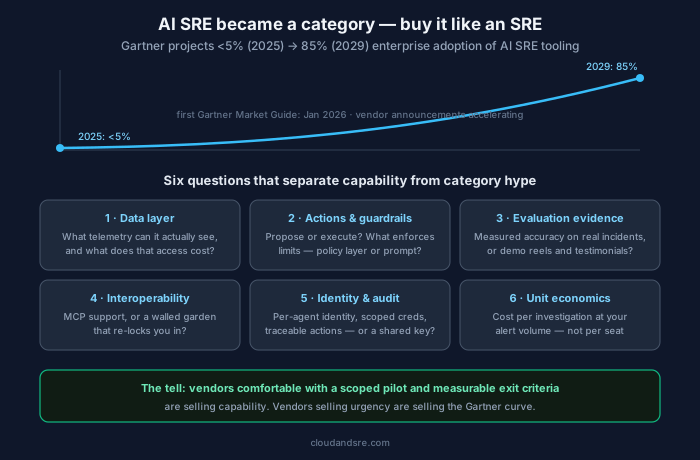
In January, Gartner published its first-ever Market Guide for AI Site Reliability Engineering Tooling. Within weeks, every vendor within shouting distance of observability had a press release about being named in it — Komodor, Cast AI, Firefly, and more. New Relic shipped an SRE Agent. The market maps are multiplying.
The headline number doing the rounds: Gartner projects that by 2029, 85% of enterprises will use AI SRE tooling — up from less than 5% in 2025. I’ve watched enough Gartner curves to know that number is a directional bet, not a forecast. But category formation is real and it changes something concrete: the buying pressure now comes from above you. When a category exists, CIOs ask why you don’t have one yet.
Which is exactly when engineering discipline in procurement matters most. So: how to shop this category like an SRE.
What category formation actually changes
Before a Market Guide exists, vendors have to sell you an outcome — fewer pages, faster incident resolution. After one exists, they can sell you membership in a trend, and the trend is genuinely strong: the SRE Report 2026 found more than half of SRE professionals planning to deploy agentic AI in production within twelve months. The economics shifted too — inference costs fell roughly 92% in three years, from ~$30 per million tokens in early 2023 to $0.10–$2.50 by early 2026, which is what makes an agent that investigates every alert plausible rather than absurd. I covered the landscape shape in the AI-native SRE stack; the short version is that agents, harnesses, and the data layer are separating into distinct competitive battles.
None of that tells you whether a specific product will work on your incidents. Category momentum is a fact about the market, not about the tool. Cutting through it takes six questions.
The six questions
1. What data can it actually see — and what does that access cost? An AI SRE is only as good as its view of your telemetry, and “integrates with your observability stack” hides enormous variance: full query access, sampled exports, or a thin webhook. Ask precisely what the agent reads during an investigation. Then ask what that does to your observability bill — some architectures effectively re-buy your telemetry through vendor queries, a cost that belongs in your token budget math from day one.
2. What actions can it take, and what enforces the limits? Propose-only or executing? If it executes: is the guardrail a policy layer outside the model, or instructions in a prompt? You want the bounded-autonomy shape — a deterministic enforcement point the model can’t argue with, which is exactly the cut Google made with Actus. A vendor who can’t crisply describe their enforcement layer doesn’t have one.
3. What measured evidence exists for accuracy? Demos are curated; ask for evaluation data instead. Benchmark results like ITBench are a floor, not proof — the distribution that matters is your incidents. Which is why the pilot design below matters more than any claim on the website.
4. Does it speak MCP, or is it a walled garden? The Model Context Protocol is now the de facto way agents reach tools; a product that supports it can use connectors you already run and be swapped without ripping out the integration layer. A product that doesn’t is asking you to rebuild your tool access inside its walls — vendor lock-in, reinvented for the agent era.
5. How does it handle identity and audit? Does each agent action carry a real identity with scoped credentials, or does the product operate through one privileged service account? Can you trace every investigation and action in your own systems, or only in the vendor’s console? If an agent’s action shows up in your audit log as a shared key, you’ve bought an anonymous inference endpoint with a nicer UI.
6. What are the unit economics at your alert volume? Per-seat pricing for a product whose work scales with alert count is a mismatch you’ll feel later. Get the cost per investigation at your actual volume, and model the noisy-week case — the whole point of letting AI triage is that it runs when volume spikes, which is precisely when usage-based pricing bites.
Run the pilot like an experiment
Category-era sales cycles push proof-of-concepts that are really guided demos. Insist on the boring version:
- One scope, real volume. A single alert stream or service, production signals, no vendor-supplied scenarios.
- Exit criteria written before it starts. Triage accuracy against responder judgment, time-to-hypothesis, false-positive rate, cost per investigation. Numbers, not impressions.
- Propose-only for the duration. Score the agent’s proposals against what on-call actually did — the same human-trajectory yardstick that serious evaluation practice uses as ground truth.
- The tell: a vendor comfortable with scoped pilots and measurable exit criteria is selling capability. A vendor selling urgency — “the market’s moving, don’t get left behind” — is selling you the Gartner curve.
Honest caveats
I haven’t run every product in this category and this isn’t a vendor ranking; representative-vendor lists are inclusion criteria, not endorsements, and Gartner says as much. The 85%-by-2029 projection describes any use of AI SRE tooling, which can be satisfied by a copilot summarizing incidents — don’t read it as “autonomous remediation everywhere in three years.” And buying well still leaves you owning the platform layer: identity, gateways, tracing, and evaluation don’t come in the box, whatever the box says. The category is real, some of the tools are already useful, and the ones worth your money can survive six questions and a scoped pilot. Shop accordingly.
Sources: Cast AI on the Gartner Market Guide, Komodor — representative vendor announcement, Firefly — Thinkerbell AI named in the guide, Augment Code — AI SRE 2026 guide (SRE Report + cost data), Mezmo — 2026 AI SRE market map
Comments